
What a good cover letter generator should (and shouldn't) do
A cover letter generator is only useful if it writes from two sources: your resume and the posting. Why generic AI letters fail, and how to judge one.
Search for a cover letter generator and you’ll find a wall of tools promising a finished letter in one click. Most of them deliver the same thing: three paragraphs of manufactured enthusiasm, an anecdote you never lived, and admiration for a company the tool knows nothing about. Recruiters recognize these letters instantly, not because the writing is bad, but because the content is invented. A generator is genuinely useful only when it works the other way around: writing strictly from what’s true. Here’s what that looks like, and how to judge any generated letter before you send it.
Why generic AI cover letters fail
Consider what a typical AI cover letter tool has to work with: a job title, maybe a company name, and nothing else. It doesn’t know what you’ve done, so it writes in adjectives (“my strong communication skills and passion for excellence”). It doesn’t know the company, so it flatters generically (“I have long admired your commitment to innovation”). And because a letter is supposed to feel personal, it manufactures the personal part: a formative project, a lifelong fascination with the industry, a story with no names or dates because it never happened.
Recruiters read stacks of letters for every posting, and the pattern is unmistakable: praise that would fit any company, claims that connect to nothing in the resume, warmth with no specifics underneath. An obviously generic letter doesn’t just fail to help. It reads as low interest, and low-interest applications are easy to skip silently (it’s one of the seven reasons behind applications that get no response). A fabricated anecdote is worse still: it’s now a claim you have to carry into the interview, defending a story a language model made up.
None of this is an argument against generating the letter. It’s an argument about inputs. A tool that knows nothing true about you can only invent, so it invents.
What recruiters actually scan a cover letter for
The useful, slightly deflating truth: most recruiters give a cover letter a few seconds, roughly the same skim they give a resume. In that skim they’re checking a short list:
- Evidence you read this posting. Its named requirements, the team’s actual work (not the company’s mission statement recycled back at it).
- Two or three concrete, relevant facts. The things you’ve done that map most directly to what the role needs, stated with enough specificity to be checkable.
- A plausible reason for the application. Why this role follows from your experience: one sentence, not a life story.
- Consistency with the resume. A letter that mentions skills or employers the resume doesn’t contain triggers exactly the credibility check you don’t want.
Notice what’s absent from the list: prose style, wit, length, declared passion. A letter that surfaces the right three facts in plain sentences beats an eloquent one that says nothing verifiable.
The two-source rule
A cover letter generator worth using draws from exactly two documents: your actual resume and the job posting. Nothing else: no invented backstory, no scraped company trivia, no template sentiment.
The logic is simple. The posting states what the employer cares about, in the employer’s own words. Your resume states what you’ve actually done. A cover letter’s entire job is to connect them: here are the parts of my real experience that answer your stated needs. Every sentence in a good letter traces back to one of those two sources, and any sentence that traces to neither is, by definition, invented. That’s the test to run on any draft, from any tool: pick a sentence, ask which source it came from, and cut it if the answer is “neither”.
The rule has a practical consequence: the letter can only be as strong as the resume behind it. If your resume doesn’t state an experience clearly, no honest generator can write about it. So the resume-side work comes first: getting your resume into a shape screening software can actually read, pulling the keywords out of the posting, and tailoring the resume to the job description. Once that pass is done, the letter falls out of the same analysis almost for free: the tailoring already identified which of your experiences answer this posting, and the letter just says so in prose.
How Sarto generates a cover letter
Sarto treats the letter as the last step of that per-posting pass. You import your real resume once (PDF, photo, or paste), add a job posting (paste it, or share it straight from another app), and the app scores the match and tailors the resume with every change shown as a diff you can reject. The cover letter is then generated from those same two sources (your imported resume and this posting) and nothing else.
The honesty rule isn’t a polite instruction in a prompt; it’s enforced by the server. The AI cannot invent employers, titles, dates, or skills. A draft containing anything your resume doesn’t support is rejected before you ever see it. If the first letter takes an angle you don’t like, regenerate: you get a different cut of the same true facts, never new ones. Export is a PDF, alongside the tailored resume.
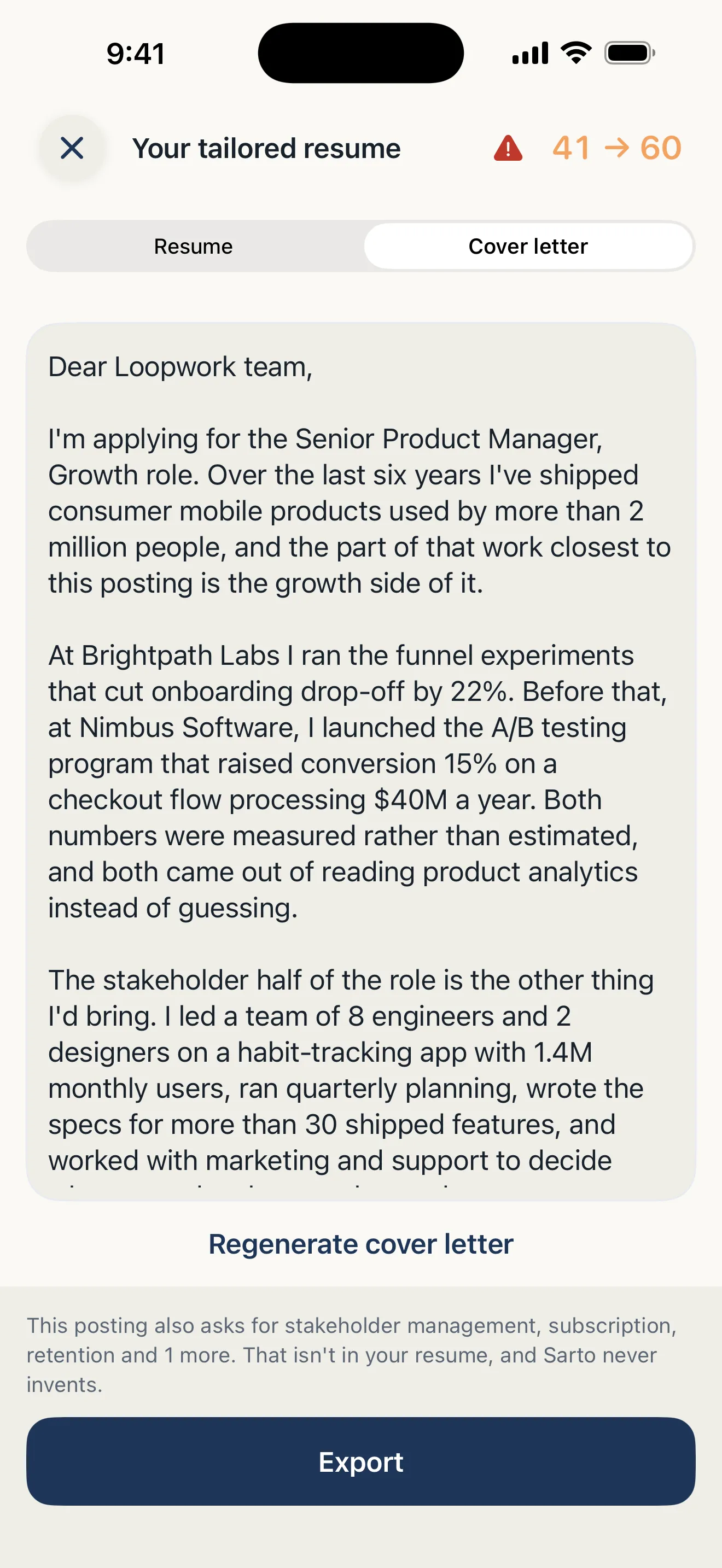
Written from two sources only (the resume you imported and this posting), under the same server-enforced no-fabrication rule as the resume tailoring.
A checklist for judging any generated letter
Whatever cover letter writer you use (an app, a chatbot, or your own late-night draft), run the result through this before sending:
- Trace every factual claim to your resume. Employers, titles, dates, skills, numbers. Anything you can’t find there, delete or verify.
- Check the specifics belong to this posting. If a sentence would fit any job at any company, it’s filler. The letter should name requirements this posting actually contains.
- Delete any anecdote you don’t remember living. Generated stories are the fastest credibility killer in a screening call.
- Read the praise out loud. If you couldn’t say it to the hiring manager’s face without wincing, cut it.
- Check consistency with the attached resume. Same titles, same dates, same claims. One mismatch invites scrutiny of everything else.
- Time the read. Under a minute. Three short paragraphs beat a full page.
A letter that passes all six may feel plain. Plain is fine. Recruiters aren’t grading style. They’re looking for a specific, true, easy-to-verify reason to move you forward.
The letter is the easy part, once the inputs are right
Much of the anxiety around cover letters comes from treating them as a writing test. They aren’t. A cover letter is a routing document: the right facts from your resume, aimed at the right requirements from the posting, in readable prose. Get those two inputs right and generating the letter takes a minute; get them wrong and no amount of eloquence rescues it. That’s the standard to hold any cover letter generator to, and the reason the useful ones are the boring ones. Two sources of truth, nothing invented, every line something you can stand behind on the phone.