
How to tailor your resume to a job description (with examples)
A practical, honest way to tailor your resume to a job description: find the posting's keywords, rephrase what you already did, and keep every claim true.
Most job seekers know they should tailor their resume to each job description. Most don’t do it, not because they disagree, but because doing it well by hand is slow, repetitive, and easy to get wrong. This guide shows the honest version of the process: what to change, what to leave alone, and what tailoring absolutely is not.
Why a tailored resume outperforms a general one
A job posting is not just a wish list. It’s the vocabulary the employer will use to evaluate you. Recruiters skim for the posting’s own terms, and applicant tracking systems rank applications by how well the text matches the role. When your resume describes the right experience in different words, that experience often counts for nothing: “worked with marketing and support teams” doesn’t register as “stakeholder management” to a keyword screen, even though it’s the same skill.
Tailoring closes that gap. Same facts, sharper wording, aimed at one specific posting.
Step 1: read the posting like a checklist
Take the job description and pull out the concrete things it asks for. They cluster in three places:
- The requirements section: hard skills, tools, certifications, years of experience.
- The responsibilities section: the verbs and nouns of the day-to-day work (“run growth experiments”, “own funnel optimization”, “manage stakeholders”).
- Repeated phrases: anything mentioned more than once matters to whoever wrote it.
You should end up with a short list of the posting’s own words. If you want the deeper method, we’ve written a whole guide on finding the resume keywords a posting screens for.
Step 2: map each keyword to something you actually did
This is the honesty checkpoint. For each keyword, ask: did I really do this? Three outcomes:
- You did it, and your resume already says so: leave it alone.
- You did it, but your resume says it in different words: rephrase. This is where almost all the value of tailoring lives.
- You didn’t do it: skip it. Do not add it. A keyword you can’t back up in an interview is worse than a lower match score.
Step 3: rephrase, don’t invent
Two real before/after examples (taken from Sarto’s demo resume, a product manager applying to a growth role):
Before: Worked with marketing and support teams to prioritize the roadmap.
After: Managed stakeholders across marketing and support to prioritize the roadmap.
Same fact. But the posting asked for “stakeholder management”, and now the resume answers in the posting’s language.
Before: Product manager with 6 years of experience shipping consumer mobile apps.
After: Product manager with 6 years of experience shipping consumer mobile apps, focused on growth experiments and funnel optimization.
Here the candidate genuinely ran growth experiments. It was buried further down the resume. The tailored summary surfaces it because this posting screens for it.
Notice what didn’t happen: no new employers, no new skills, no inflated numbers. Tailoring is emphasis and translation, never fabrication.
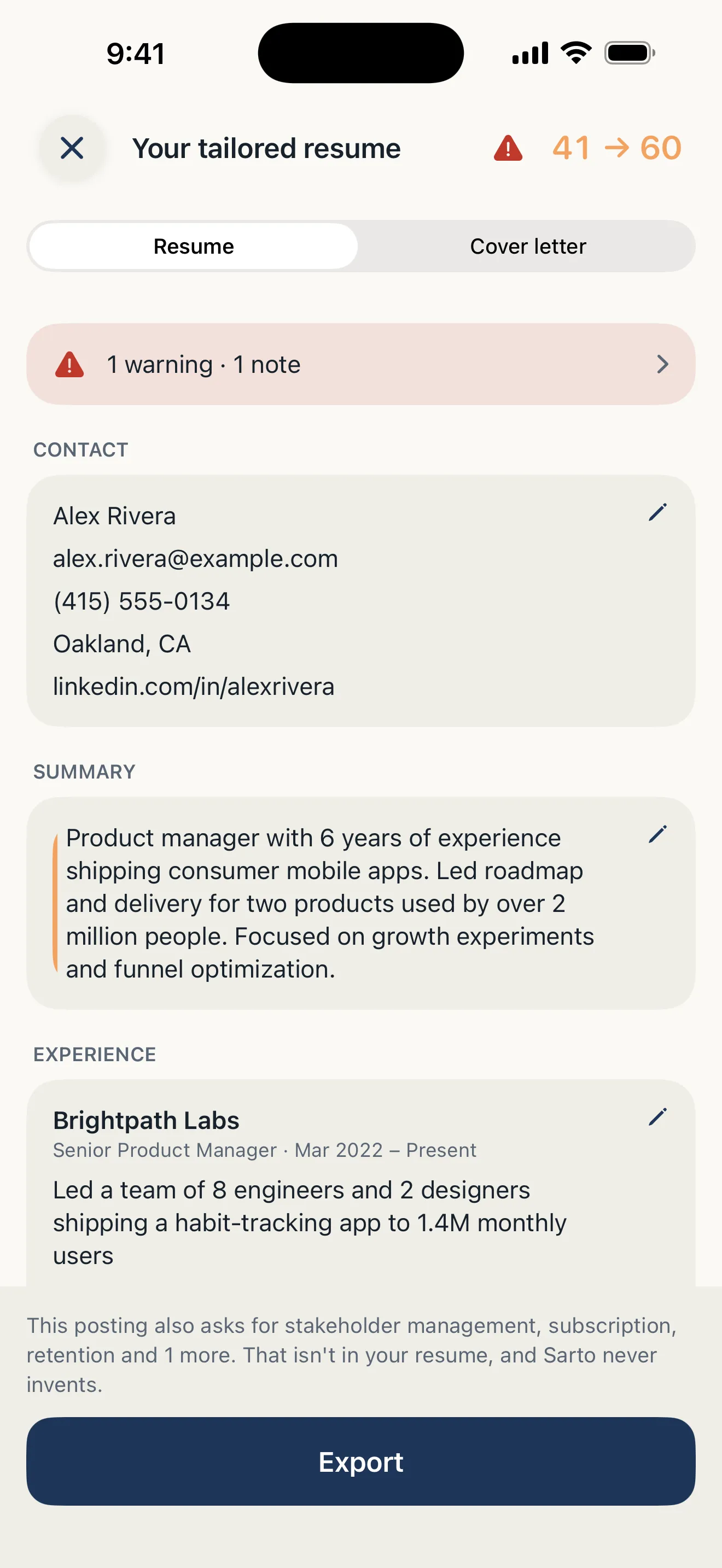
This is what the rephrasing step looks like in Sarto. Every change is a diff you can reject, and the banner says it plainly: nothing was invented.
Step 4: reorder for the first skim
Beyond wording, order matters. Put the most relevant experience where a skimming reader will hit it first: the summary line, the top bullets of your most recent role, the first row of your skills section. The goal is that someone reading only the top third of your resume sees the posting reflected back at them.
Step 5: check your coverage before you send
After rewriting, verify the gap actually closed. Reread your keyword list against the final text, or use a tool that scores it. This is exactly what an ATS resume score is for: a number for how much of the posting your resume now covers, and a list of what’s still missing.
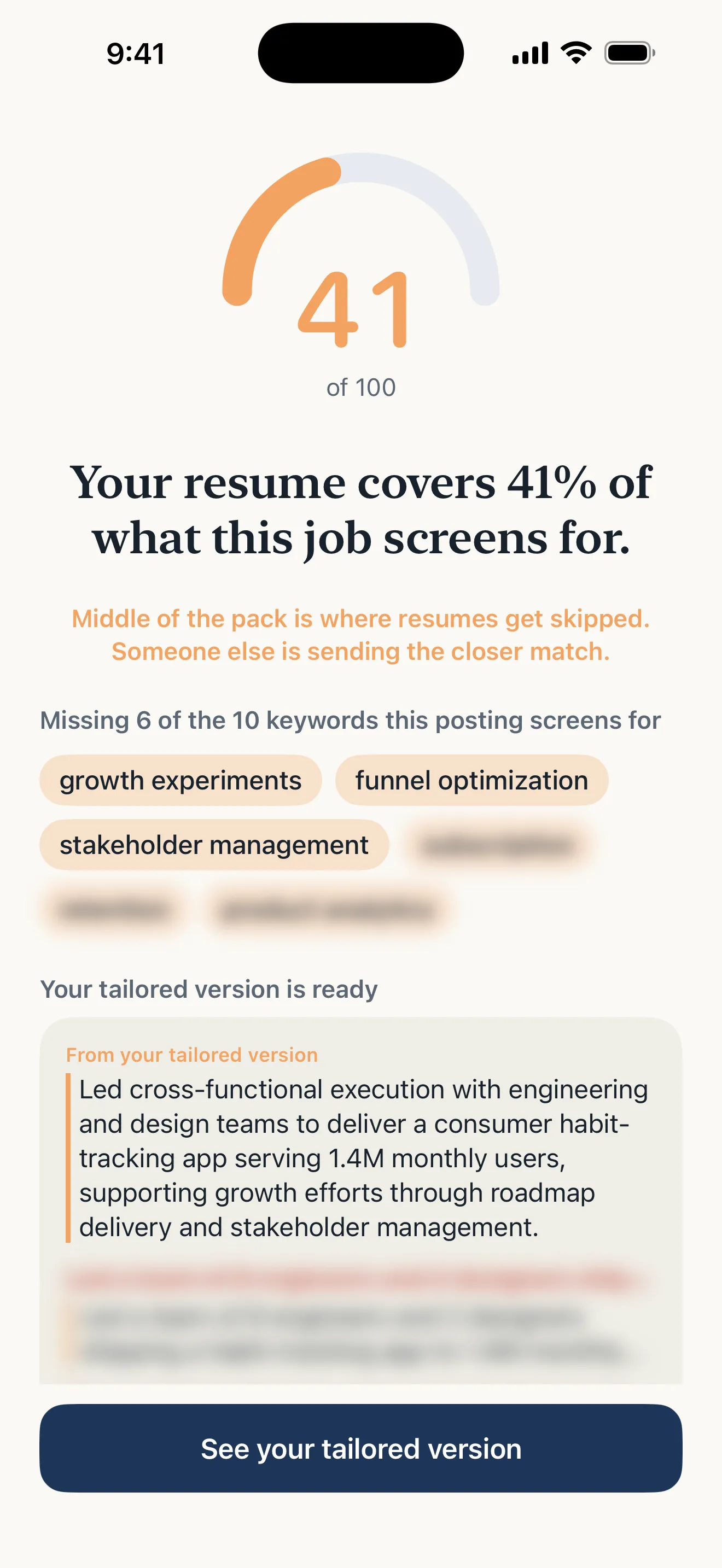
Coverage before the rewrite: the missing keywords are the checklist for step 2.
What tailoring is not
Worth stating plainly, because plenty of AI tools get this wrong:
- It is not adding skills you don’t have.
- It is not changing job titles to match the posting.
- It is not stuffing a keyword list in white text at the bottom (parsers flag it, humans fire you for it).
If a tool “improves” your resume by inventing, you inherit the lie at interview time.
Doing this for every application
The process above takes a focused 30–60 minutes per posting by hand. That’s the real reason most people send the same resume everywhere, and then hear nothing back.
This is the problem Sarto exists to solve: import your resume once, paste a posting, and get the tailored version in about a minute: rephrased and reordered only from what your resume already contains, with every change shown as a diff you can reject, plus the match score and the matching cover letter. The honesty rule is enforced by the server, not by a prompt: nothing invented, ever.