
Resume keywords: how to find the ones a posting screens for
Resume keywords are hiding in plain sight in every posting. How to extract them, which ones matter most, and how to add them without stuffing or lying.
“Add keywords to your resume” is the most repeated and least explained advice in job searching. Which keywords? From where? How many? This is the concrete version: how to pull the resume keywords out of any job posting, decide which ones matter, and work them in without turning your resume into a word salad.
Keywords come from the posting, not from a master list
Generic keyword lists (“leadership”, “team player”, “results-driven”) are close to worthless. They’re what everyone adds, so they distinguish no one, and they’re rarely what a recruiter actually searches. The keywords that matter for this application are sitting in this posting. Every job description is, unintentionally, a cheat sheet: it’s written in the exact vocabulary the employer will use to search and rank applicants.
Where they hide in a posting
Read the posting three times, each with one filter:
1. Hard requirements. Tools, technologies, methodologies, certifications, domains. “SQL”, “A/B testing”, “HIPAA”, “React”, “P&L ownership”. These are the strongest keywords because they’re the most searchable: a recruiter filtering candidates types these exact strings.
2. Responsibility verbs and their objects. The day-to-day work, phrased the way the team phrases it: “run growth experiments”, “own funnel optimization”, “manage stakeholders across marketing and support”. The noun phrases here (“growth experiments”, “funnel optimization”, “stakeholder management”) are what ranking algorithms and skimming humans both look for.
3. Anything repeated. If “customer insights” appears in the summary, the responsibilities, and the requirements, it’s load-bearing. Whoever wrote the posting cares about it. Repetition is the posting telling you its priorities.
You’ll typically end up with 10–20 phrases. That’s your checklist for this one application.
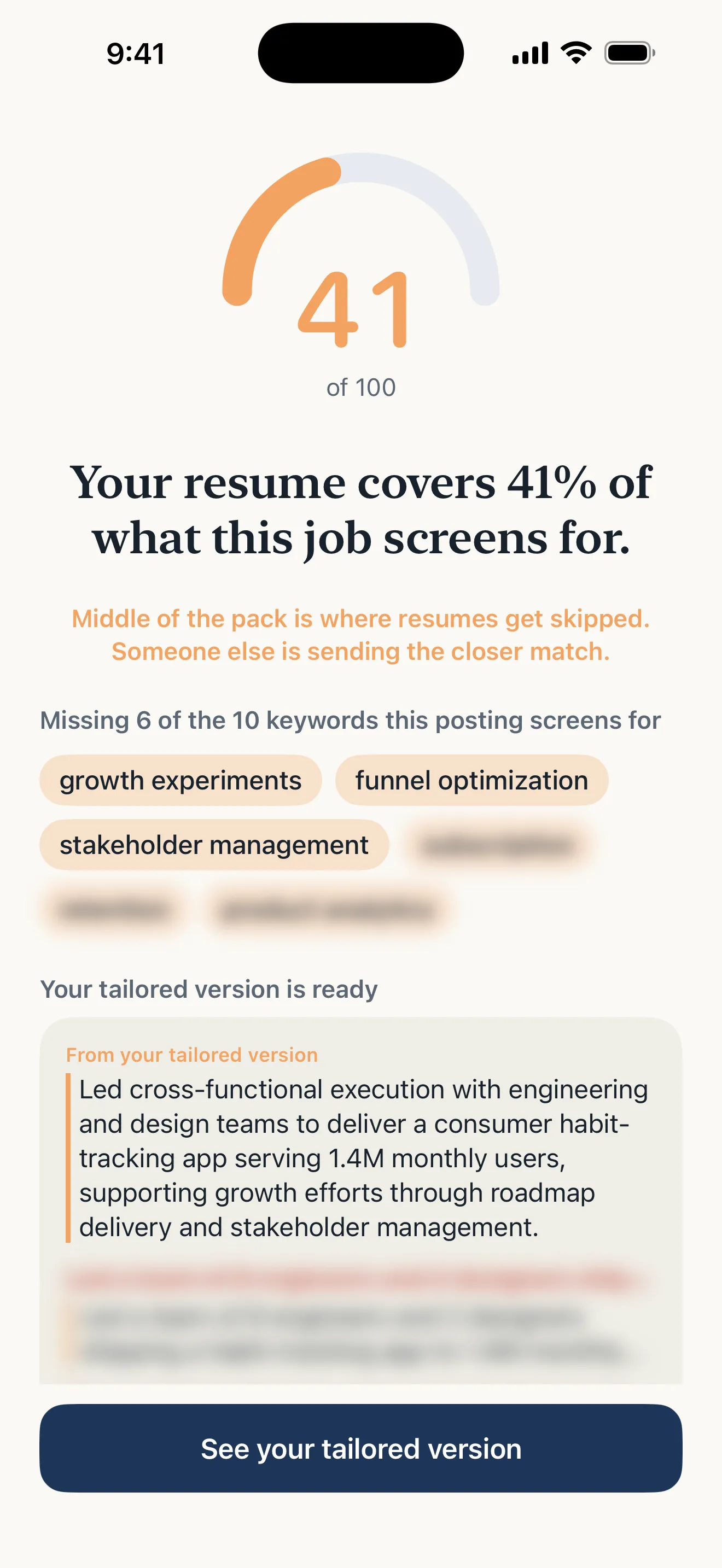
What the extracted checklist looks like when a tool does it: the posting’s keywords your resume doesn’t cover yet, listed one by one.
Which ones actually matter
Not all keywords are equal. Rough priority order:
- Named skills and tools in the requirements section: most often searched literally.
- Repeated phrases: the posting’s stated priorities.
- Role-specific noun phrases from responsibilities: how the work itself is described.
- Soft skills: lowest value as keywords; show them through accomplishments instead of listing them.
If a posting is long, focus on the top two tiers. Covering eight core keywords well beats grazing twenty.
Adding them without stuffing
The rule: a keyword earns its place by attaching to something you actually did.
- Rephrase existing bullets into the posting’s vocabulary. “Worked with marketing and support teams to prioritize the roadmap” becomes “Managed stakeholders across marketing and support to prioritize the roadmap”. Same fact, now findable.
- Surface buried experience. If the posting screens for “funnel optimization” and your funnel work is bullet six of an old role, bring it into your summary or top bullets.
- Use the exact form once. Parsers are literal-minded; if the posting says “A/B testing”, write “A/B testing”, not only “split experiments”.
And the anti-rules:
- Don’t paste a keyword block or hide white text: it’s searchable, detectable, and disqualifying.
- Don’t claim tools or skills you haven’t used. A keyword you can’t discuss for five minutes in an interview is a trap you set for yourself.
- Don’t change job titles to match the posting. That’s fabrication, and it unravels at reference checks.
Check your coverage
Once you’ve rewritten, measure the gap instead of guessing: compare your resume against the checklist, or use a scorer that does it mechanically. That’s exactly what an ATS resume score is: keyword coverage as a number, with the missing ones listed. The full rewrite workflow around it is covered in how to tailor your resume to a job description.
The part nobody has time for
Extracting keywords, mapping them honestly against your experience, rephrasing, re-checking (per posting) is real work. It’s why most people skip it, send the general resume, and hear nothing back.
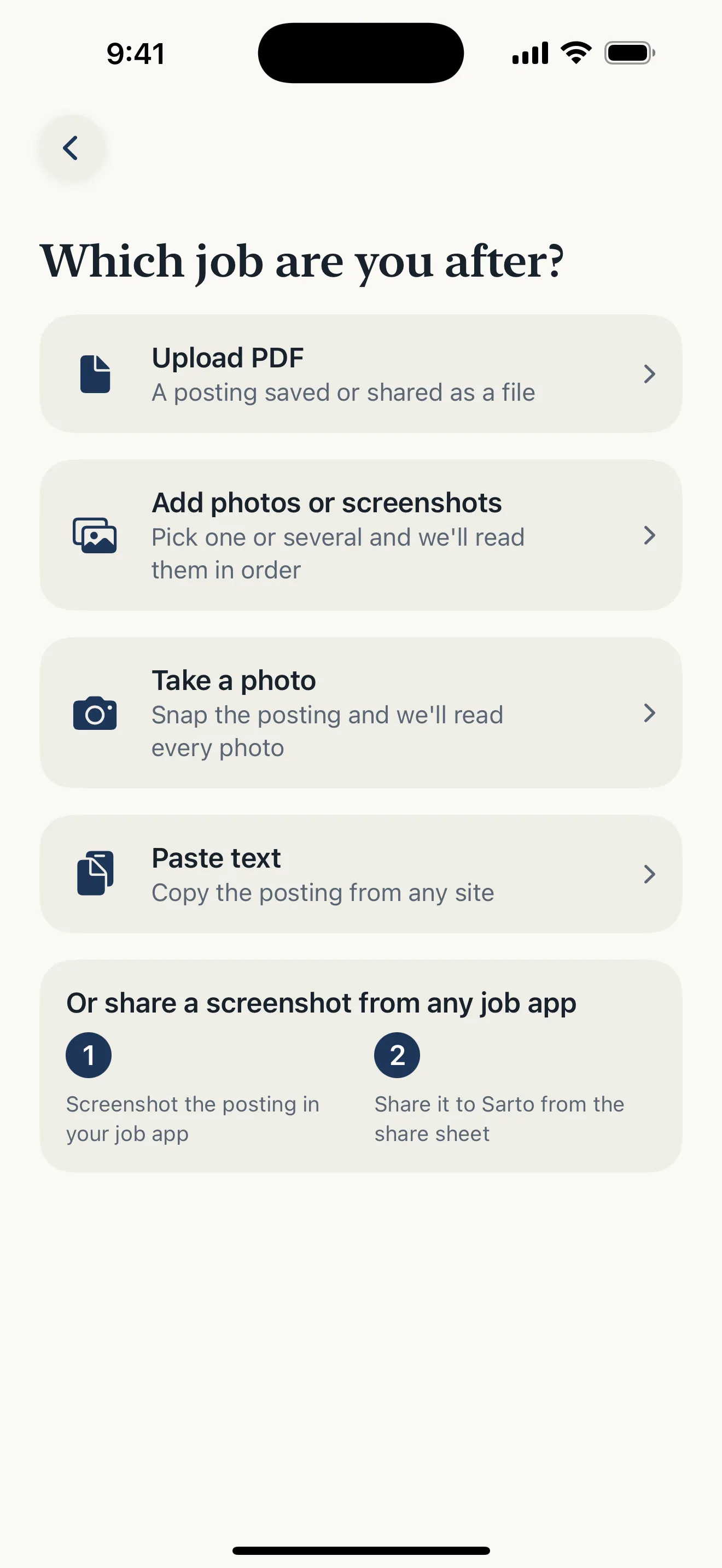
Any way you can capture a posting (text, photo, screenshot) works as the input.
Sarto mechanizes exactly this loop: paste a posting and it extracts what the posting screens for, scores your resume against it, and rewrites only from what your resume already contains: every change a reviewable diff, keywords you’re missing shown as chips, nothing invented. The keyword checklist above, done in about a minute.