
No response to job applications? Seven fixable reasons
Getting no response to job applications usually has fixable causes: generic resumes, missing keywords, formats parsers misread. Here are seven, with fixes.
You send the application. Nothing. Again. No rejection, no feedback, just silence. When you get no response to job applications for weeks, it’s tempting to conclude the market is broken or your career is the problem. Usually it’s neither. Silence has causes, most of them mechanical, and most of them fixable this week.
1. You’re sending the same resume to every job
The most common cause. A general resume describes your experience in your words; every posting evaluates it in its words. Recruiters skim for the posting’s terms, and applicant tracking software ranks by them. The same resume that’s a 40% match for one posting can be an 85% match for another. Sending it unchanged everywhere means you’re strong for a lottery of roles and invisible for the rest.
Fix: tailor per posting. It’s a mechanical process, not a dark art. Here’s the step-by-step method with examples.
2. The posting’s keywords aren’t in your resume
A sub-case of #1 so common it deserves its own line. You did the work; your resume just names it differently. You wrote “worked with marketing and support teams”; the posting screens for “stakeholder management”. To a keyword search, that experience doesn’t exist.
Fix: extract the posting’s vocabulary and close the gaps on experience you genuinely have. Guide: how to find the keywords a posting screens for.
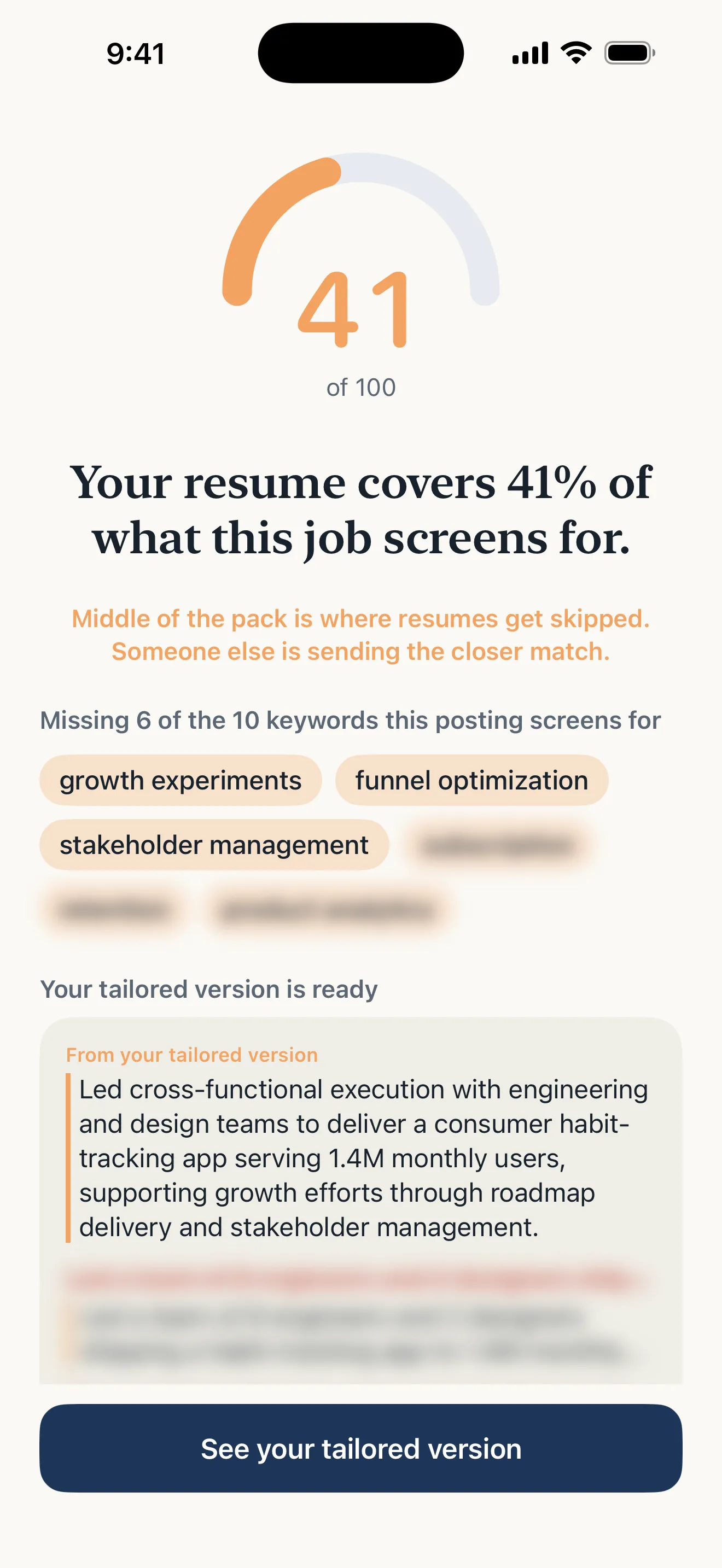
This is what silence looks like before it happens: real experience, described in words the posting doesn’t use.
3. Your resume’s format defeats the parser
Before anyone reads your resume, software usually parses it into structured fields. Multi-column layouts, text inside graphics, tables, headers/footers with contact info, and designer templates can scramble that extraction: your dates end up attached to the wrong employer, or a whole section vanishes.
Fix: single column, standard section names (“Experience”, “Education”, “Skills”), real text (never a screenshot of text), contact info in the body. Export a text-based PDF or .docx, not an image-based one.
4. The top third of your resume doesn’t answer this posting
Even when a human does read it, the first look is a skim of the summary and the top bullets. If your most relevant experience for this role is buried on page two, the skim ends before the evidence starts.
Fix: reorder per application. Summary line and top bullets should reflect this posting’s priorities. Reordering is part of tailoring, and it’s completely honest.
5. You’re only applying to high-competition postings
A posting that’s a week old on a major board has often accumulated hundreds of applicants; ranking in the invisible middle produces exactly this silence. This isn’t a resume flaw, but it compounds every one of the flaws above: in a deep pool, only high-match applications surface.
Fix: apply earlier (set alerts), include less-saturated channels, and make sure the applications you do send are high-match rather than high-volume.
6. No cover letter where one was expected
Plenty of roles ignore cover letters. But where one is expected (smaller companies, career changes, anything client-facing), its absence (or an obviously generic one) reads as low interest, and low-interest applications are easy to skip silently.
Fix: when you tailor the resume, generate the letter from the same analysis: why this role, backed by the two or three most relevant things you’ve done. It should take minutes, not an evening.
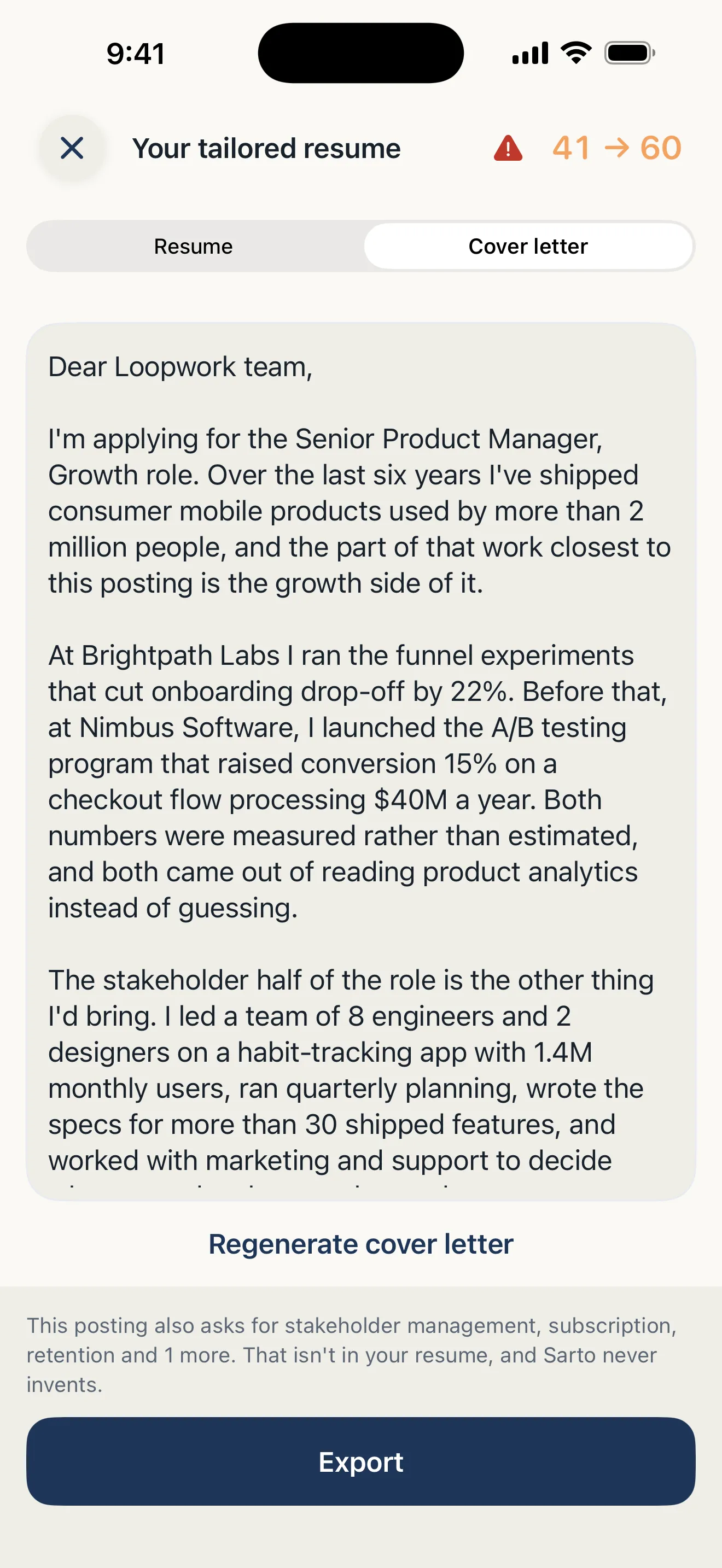
A letter generated from the same tailoring pass: specific to the role, done in the same minute.
7. The claims don’t hold together
Inflated titles, stretched dates, or keyword-stuffed skills sections often pass the software and then die at the first human read or the first screening call, with no explanation, because nobody explains a credibility rejection. If you’ve “optimized” your resume with tools that invent, this may be the silence you’re hearing.
Fix: keep every line defensible. The strongest resume is your real experience, phrased in the posting’s language, nothing more. (This is why Sarto enforces its honesty rule server-side: rephrasing and reordering only, every change a reviewable diff, fabrication rejected.)
The pattern behind all seven
Notice what these have in common: none of them mean “you’re not good enough”. They mean the matching layer between you and the job (wording, order, format, follow-through) is failing before your actual experience gets evaluated. That layer is fixable per application, and measurably: an ATS resume score tells you, before you send, whether this application will register or vanish.
That loop (score, see what’s missing, close the honest gaps, send) is exactly what Sarto does in about a minute per posting: import your resume once, paste the job, review the diff, export with the cover letter. The silence usually isn’t about you. It’s about the match being invisible, and that part you can fix.